Theme notesCaries & prevention
Theme notesCaries & prevention
Caries, prevention & the durable restoration
Start with the child’s disease risk. Control the process, choose care the family can sustain, and match the restoration to the tooth’s future.
In these pathways, F means fluoride; SDF silver diamine fluoride; ITR interim therapeutic restoration; GIC glass ionomer cement; RMGIC resin-modified glass ionomer cement; and SSC/PMC a stainless-steel/preformed metal crown. OH means oral hygiene and GA general anesthesia.
Remember
Risk → control → restore → reassess.
Caries as a disease process
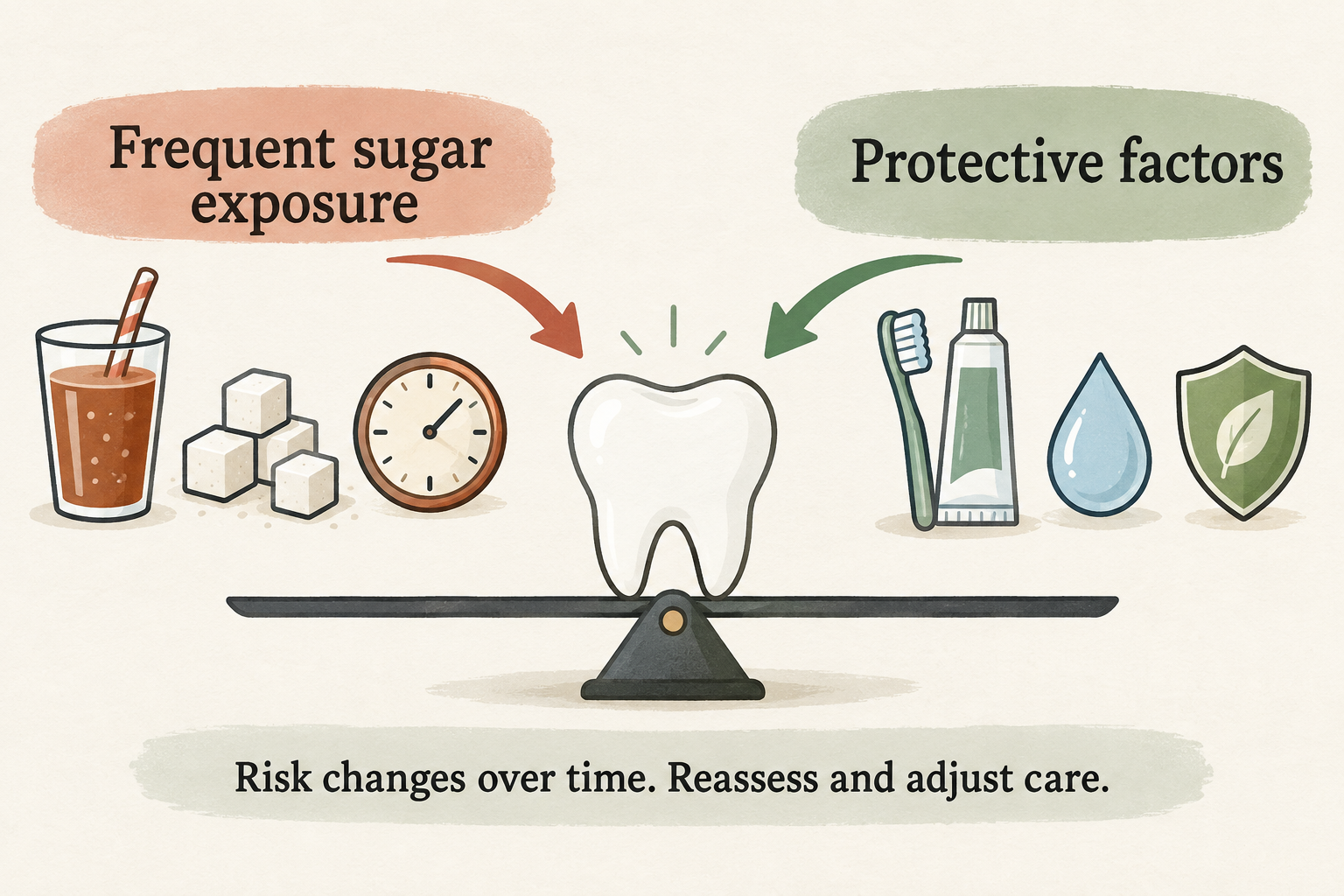
Conceptual memory aid, not a risk score or an AAPD figure. Frequent sugar exposure supports biofilm acid challenges; saliva, fluoride, and plaque control help protect teeth. Assess disease indicators and the individual patient's circumstances together. Restorations repair damage; prevention and reassessment address the disease process.
Key points
Combine disease indicators, risk factors, and protective factors. Reassess risk at each periodic visit; a checklist total is not a validated prediction.
Caries risk (PDF opens in a new tab)Twice-daily age-appropriate fluoride toothpaste is the foundation. Add professional fluoride by risk; audit drinking water and all fluoride sources before supplements.
Fluoride (PDF opens in a new tab)Restoration choice depends on pulp status, lesion extent, remaining structure, isolation, cooperation, and time to exfoliation. Extensive high-risk primary lesions often favor a stainless-steel crown.
Restorative care (PDF opens in a new tab)Answer aloud
How does caries management change when a lesion is noncavitated, cavitated, or progressing?
Noncavitated lesions can receive preventive care and active surveillance. Cavitation or progression prompts an arrest/restorative plan; explain how you will control disease and verify success.
Caries risk (PDF opens in a new tab)Restorative care (PDF opens in a new tab)When should you consider silver diamine fluoride or an interim therapeutic restoration?
SDF can arrest suitable cavitated lesions within a comprehensive plan; obtain consent that the lesions will stain black. An interim therapeutic restoration can control disease when definitive care must wait. Both need reassessment.
Fluoride (PDF opens in a new tab)Restorative care (PDF opens in a new tab)Should you remove all carious dentin when treating a deep caries lesion?
First establish pulp status. With normal or reversible pulp, selective removal can reduce exposure risk; a durable seal is essential. Use the pulp theme for tooth-specific treatment choices.
Restorative care (PDF opens in a new tab)Compare restorations by tooth
Scroll across to view all columns
| Situation | Usual option | Key limit |
|---|---|---|
| Small to moderate primary Class I or II | Composite, amalgam, compomer, or RMGIC | Composite needs isolation and cooperation; amalgam Class II stays within the proximal line angles; conventional GIC is supported for primary Class I, not recommended for primary-molar Class II; anterior uses differ |
| Large or multisurface primary molar, high risk | Stainless-steel crown | Full coverage; zirconia may replace it for esthetics, with more reduction and at least 2 mm abutment height |
| Restorable primary molar, cooperation or access barriers | Hall technique: SSC with no anesthesia, excavation, or preparation | Requires suitable vital pulp, no infection, and a sealable crown; monitor symptoms/integrity; comparisons with conventional crowns remain limited |
| Primary incisor, Class III or V | Resin if isolable, otherwise RMGIC or GIC; full crown if extensive or high risk | Strip crowns were about 80% retained at 3 years |
| Permanent Class I or II | Composite or amalgam | GIC and RMGIC lack long-term evidence in permanent teeth; composite needs more replacement at 7–10 years |
Quick decisions
What is the foundation of fluoride prevention, and when should you add professional fluoride or supplements?
2×/day toothpaste is the base; add professional F by risk; audit all sources before supplements
What restoration is often preferred for extensive caries in a high-risk primary tooth?
often favor a stainless-steel crown
Decision pathways
Sources
- Caries-risk Assessment and Management for Infants, Children, and Adolescents, Latest revision 2022
- Fluoride Therapy, Latest revision 2023
- Pediatric Restorative Dentistry, Latest revision 2022
- Use of Non-Vital Pulp Therapies in Primary Teeth, Published 2020; article last revision June 13, 2020
- Use of Vital Pulp Therapies in Primary Teeth 2024, Published 2024; article last revision September 12, 2023
- Guideline for Use of Vital Pulp Therapy in Permanent Teeth, Published 2025; article last revision July 20, 2025